Security and privacy
A reporter's trust depends on the security of the channel
If employees don't believe their identity is protected, they won't use the channel. These are the requirements that matter and how we address them.
What the law and the authority expect from a secure channel
- A system designed, set up and run securely (art. 5.2.b).
- Confidentiality of the reporter's identity and access limited to authorised people (arts. 32 and 33).
- The ability to report anonymously (art. 7.3).
- Deletion of data that should not be kept (art. 32).
- A secure platform with end-to-end encryption, according to AIPI Recommendation 1/2026, which proposes it in proportion to each entity's size and risk.
How we address it
- Where data is hosted: Vultr, Amsterdam data centre (Netherlands)
- Role-based access with an access log
- Tools to delete data within the legal deadlines
We provide the technical security detail and the data processing agreement during the demo.
Encryption and key management
This is how the platform protects the content of reports, files and access:
- Reports and case records
- Encrypted with XChaCha20-Poly1305 (authenticated encryption). Each record is cryptographically bound to its case.
- Attached files
- Encrypted with XChaCha20-Poly1305 in authenticated 64-kilobyte segments.
- Case keys
- Sealed to each organisation's public key (X25519 sealed boxes), so only authorised staff who hold the private key can decrypt case data.
- Staff passwords
- Processed with Argon2id on the user's device. The plain password is never sent to or stored by the service.
- Reporter access codes
- Processed with Argon2id to derive separate keys for identification, authentication and decryption.
- Recovery keys
- Generated from 256 bits of cryptographically secure randomness and include a SHA-256 checksum.
- Audit log
- Protected with a SHA-256 hash chain so any alteration can be detected.
- Data in transit
- Protected with TLS 1.3 only.
- Access by our team
- Línea Anónima staff cannot read the reports, messages, files or voice if they access the database, the backups, the infrastructure or ordinary administration. The content is encrypted in the browser with keys held by the organisation.
Technical description supplied by Línea Anónima. Hosting, sub-processors and security measures are set out in the data processing agreement, which we review with you in the demo.
What the encryption does not promise
The platform itself tells reporters this, and we say the same here:
- A synthetic-voice message is decrypted in the memory of the voice processor while it is transcribed and read back; it is not stored and nobody listens to it. That depends on who can administer that server, not on it being impossible.
- The servers and the hosting network see the IP address for as long as the connection lasts. Línea Anónima does not store network data that identifies the reporter.
- A malicious change to our software could store more data.
- Encryption does not hide the visit from the organisation's network: whoever administers a work network can see that someone entered.
- Voice distortion makes a voice harder to recognise, but does not guarantee it.
- Deleted data disappears from the live system at once and from backups within 30 days.
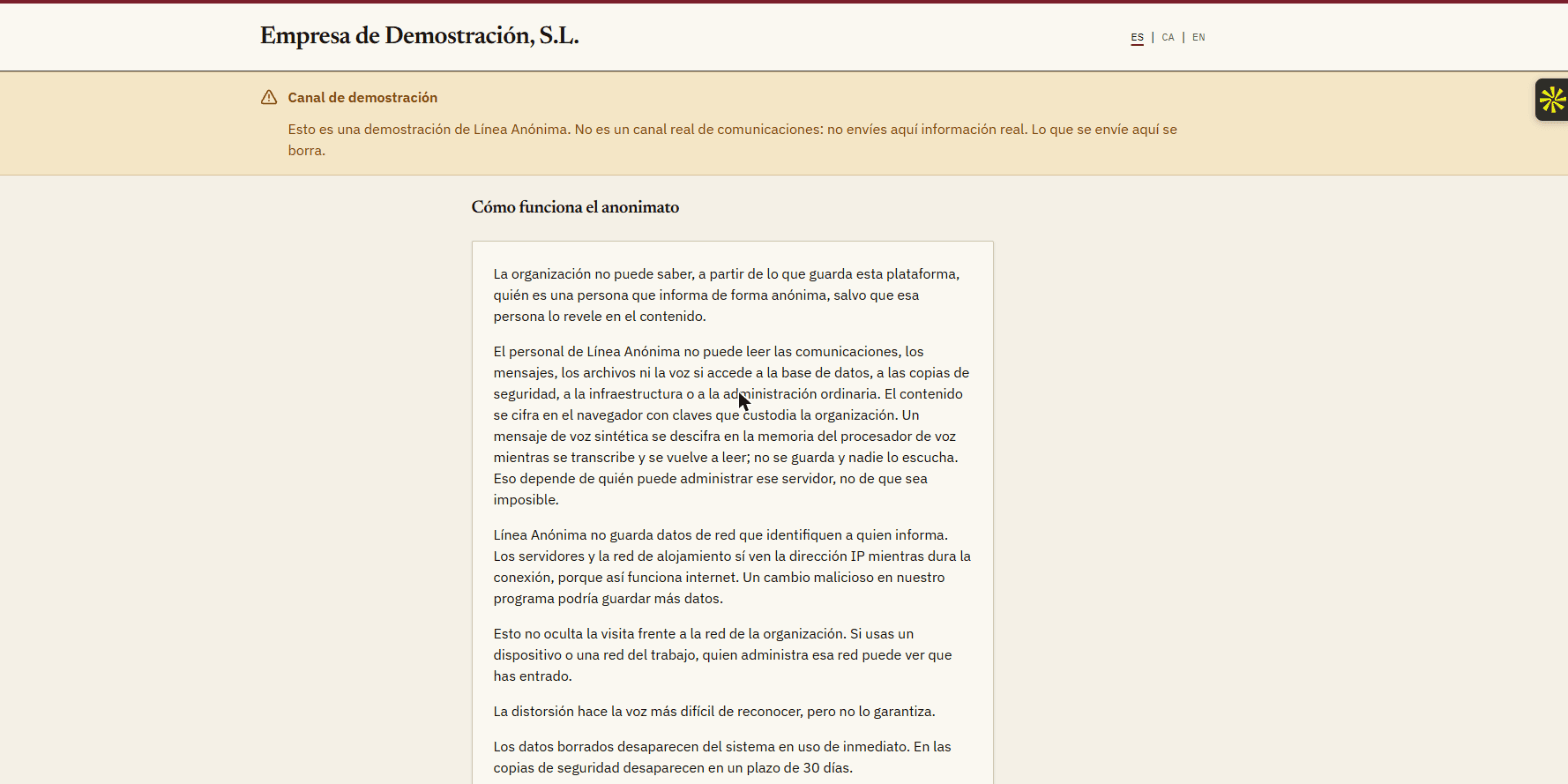
A page explains frankly what the platform protects and what it does not: for example, that a work network can see the visit and that voice distortion does not guarantee anonymity.
Who is responsible under the GDPR
By law, the administrative body of the company that sets up the channel is the data controller for the system's personal data (art. 5.1). Línea Anónima acts as data processor and signs the corresponding agreement with you.